
Every time I post or write an article featuring a Royal Enfield, the trolls come out of their dank caves (or their mother’s basements) to moan with statements like ‘what you need in the Himalayas is a KTM mate!’ or ‘that Indian-made bucket of bolts wouldn’t last a week where I ride.’ And further blah, blah, blah statements. So if you are one of those, you mother is calling you and she wants you to take out the recycling.
For you aficionados and those with an open mind, feel free to put the kettle on, take a load off and read about a motorcycle for 10 minutes. But if you have ADD and only have 1 minute, here then are some bullets:
Great
· It now looks and feels like a real motorcycle
· The functions very well as an all-rounder, whether on boring pavement or fabulous rivers
· Solid build takes beaucoup abuse and keeps on rocking
· Tugs like a pitbull over 4,500 metre passes
Hate
· Beige
· Instrument console tries to keep pace with KTM but (likely) doomed to break
· No elevation display (this is a Himalayan, after all)
· Beige
Now the full disclosure. I founded Two Wheeled Expeditions, and we own 30 Royal Enfield 450 Himalayans, so yeah, I think highly of the machine. But RE doesn’t own me (nor did they give us a discount) so I will, as always, speak with the full level of criticism that my purple Mohawk would afford. Naturally.

The first thing to get into your head when considering this bike is to come to terms with what it is not. It is not a BMW GS in any size or configuration. It is not a Teneré. And it has absolutely nothing in common with my exceptional KTM 450 EXC. It cost a fraction of these bikes, but it does what it does better than any of them.
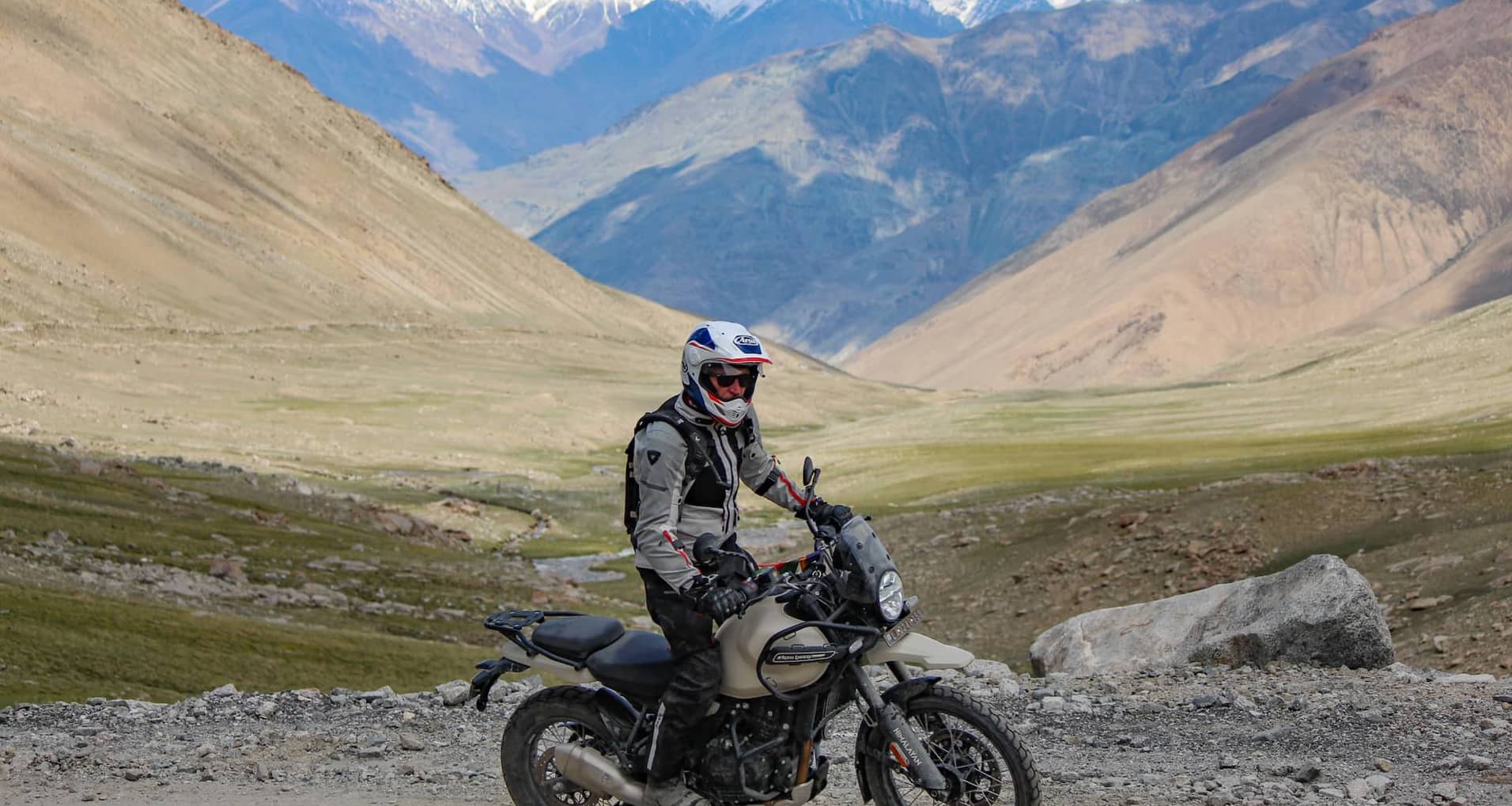
To the bike: Let’s start with the colour, shall we. Innocuous enough, right. My partner Josh, bless his Bollywood handsomeness, convinced me to get the beige ones. ‘A nice blank canvas’, said the artist in him. Well despite its resurgence as the ‘colour of the season!' in all the glossy magazines (the last time it had this accolade was when I wore a beige, corduroy suit to a prom in 1980), I..ABSOLUTELY..HATE..IT. That being out of my system, we can move on to more substantive, grown-up topics.
The Aesthetic
I remember when I sat on the bike about a year ago at the dealer in Delhi. I felt like a real motorcycle! It’s taller. It’s wider. It Iooks modern. It doesn’t sound like a lawnmower. Indeed, RE has made some more ‘modern’ bikes for a time now including the Interceptor and the Continental GT. It was only a matter of time before all that R&D made it to the dual sport, water-cooled engine and all.
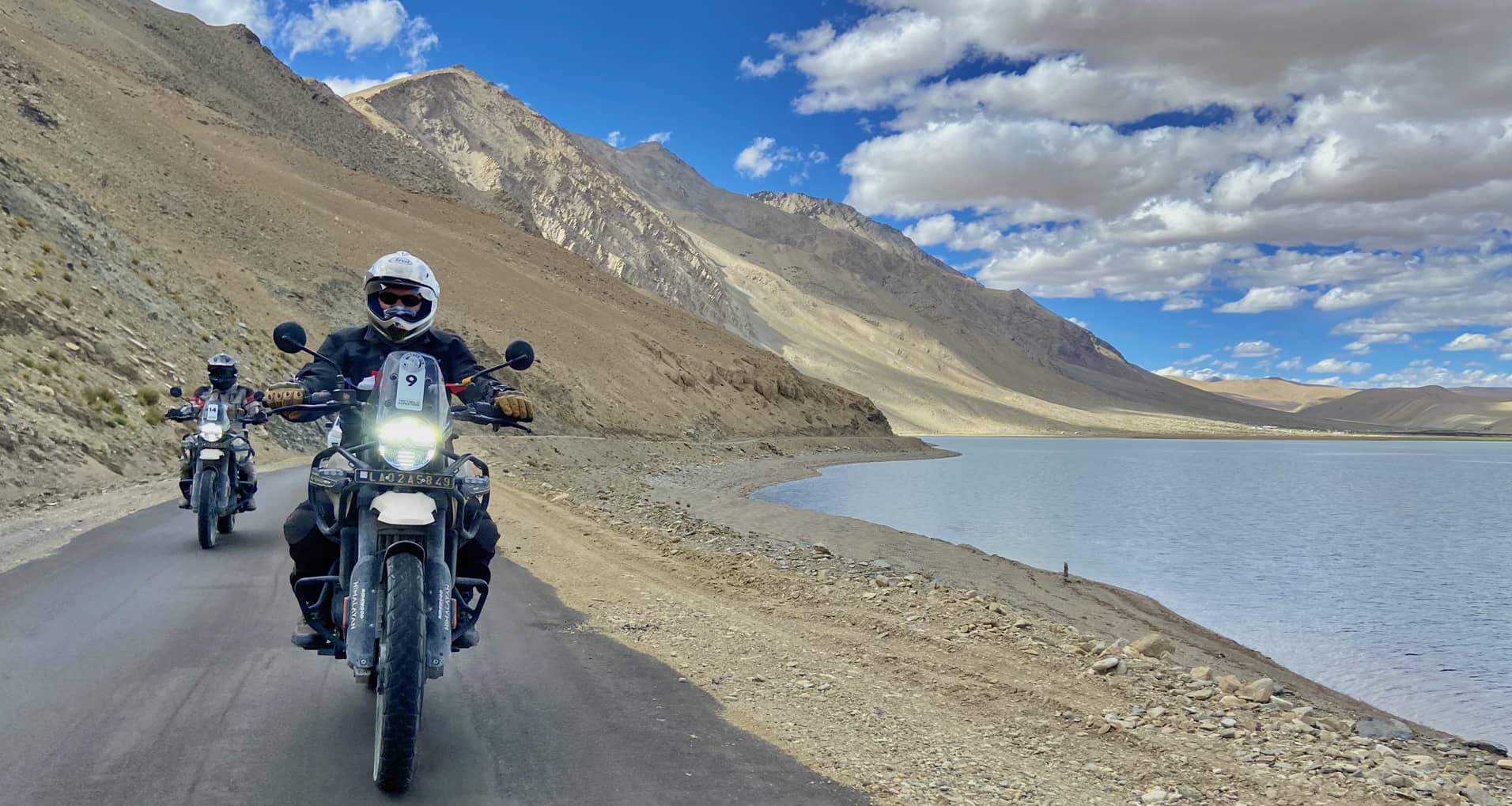
Some may complain about the bulbous tank, but for my eyes the styling hits the mark. It looks robust, purposeful and capable. The standard fairing guards help give it that ‘tonk’ vibe and the after-market engine guards we installed kept the motor looking pristine. On our 2,200km Kathmandu - Lhasa – Kathmandu loop, I noted at least a dozen falls in our 13 bike entourage. The guards did the job and the important bits were saved.

Further enhancing the trail bike cred is the 21 inch front wheel, sturdy on/offroad tyres, extended mud guards and respectable ground clearance and suspension travel. All of these design attributes aren’t just style points. The contribute to the making of a truly capable mid-sized adventure bike.
Riding Position and Controls
I’m bestowed with 170 vertical centimetres, a condition I’ve suffered with since I was 17. My doctor says it is incurable. As a consequence, I have never flatfooted either of my GS’s or my KTM 790 Adventure and the Hima is no exception. With an 800mm stock seat height, those with my affliction will suffer the same tippy toe fate. So we deal with it or, as we have done with 4 of our bikes, we installed linkage kits from RallyRaid to drop it by 5-6cm. The riders in the group who opted for the lowered bikes were unimpressed at first (lower, they would not go although we did lower the front at the triple clamp to lose a bit more height) but they with time became more strategic in the stopping points to find steadier footing.
Riding is a perfect, upright position and standing on the pegs for hours (and hours) over Nepal’s worst roads posed no problem. Taller riders (bless their elongated statures) may want to install handlebar risers for the standy bits. And over 2,200 km, I hurled no profanity at the seat.
The controls are straightforward and robust but I do have one gripe: I understand RE wants to roll with the cool kids and feature tech in the console. But the first think I noted on the Delhi test ride was, ‘that posh display will be the first thing to break.’ Call me mister grumpy old school, but I would have opted for analog instruments. We did have some issues with the ride control setting popping from Performance to ECO and ‘poof’ went the power. RE is looking into this. And why, why does a bike called the Himalayan (which we ride in the Himalayas) not have an elevation display? If I am at 5,000 metres, I’d kind of like to know that so I can bust out the oxygen tank before I pass out.

Engine
A bag of nails. That’s how I once characterised the old, air-cooled thumper. Let’s face it: the 411 was a good bike, but the engine, while as capable as a chugger to get you over the Himalayas, was about as primitive as the Brigg’s & Stratton on my first minibike. Just add pull-starter. The new bike is proper. Water cooling and a respectable rev range make the difference and now it feels like a real engine. And like all things Enfieldy, those little engines have the snort to get you through anything, even when the air is thin. We rode our cappuccino flavoured machines up to elevations of 5,300 meters. Wow, that’s a high as Everest Base Camp, I hear you exclaim. That’s because it was Everest Base Camp.
For all its glory, if you’re expecting a KTM–like high-revving single, hunch over and wait for sadness. This is a simple bike delivering capable power and incredible value. Challenge anything on the Autobahn it most certainly will not. But it does have a sweet spot and that is called 5,000. Once the rev counter hits that magic number, something slightly symphonic happens. All those bits of metal seem to join hands and sing in harmony and it starts to pull like the old bike never did. Nice!
Suspension
Yeah, that. Like the old Hima, if I was to cruise the web looking for upgrades, here is where I would start. The rear shock (made by Hagon or Showa) has an adjustable pre-load and the ring is quite accessible for making changes on the road. Our route from Kathmandu to Lhasa ranged from some of the worst roads in Asia (Nepal side) to some of the best (Tibet side). Being able to dial up the pre-load for the rocky switchbacks as we headed up to the border was welcomed like a mama’s hug. However, if you are going to spend a ton of time on the rough stuff, and upgrade is highly recommended. Öhlins makes one for £800 (coffee spews from my face) but lots of aftermarket shops make more reasonably prices sets. But to be fair, if you are a fair-weather gravel rider, the stock sticks will suit you just fine.

Here’s the deal. The new Hima has its place, without a doubt. Honestly, as someone who lives in Europe where motorway driving is a necessary evil, I would never have the Hima as my only bike. If you live somewhere where B roads and ‘no roads’ are on tap, then yes, it could function as your all day all-rounder. It provides great value, it is very well made, it handles the rough stuff like a mountain goat and it looks bloody good (unless its beige). For our company, on the challenging terrain where we spend most of our time, the new Hima is perfection and our customers love it. Be a hater, if you must, but grab one, hit some trails and you will likely feel a wee grin starting to peel across your face.
Based in London, Delhi and Austin, Texas, we are a group of people with one concise mission: To expose as many people as possible to the ultimate high of motorcycling the globe.
We believe that travel is the key to understanding our planet and our own place on it. When combined with our love for motorcycles as the mechanism for exploration – out there and at one with the elements – Two Wheeled Expeditions creates experiences like none other in the world.


.png)
.png)