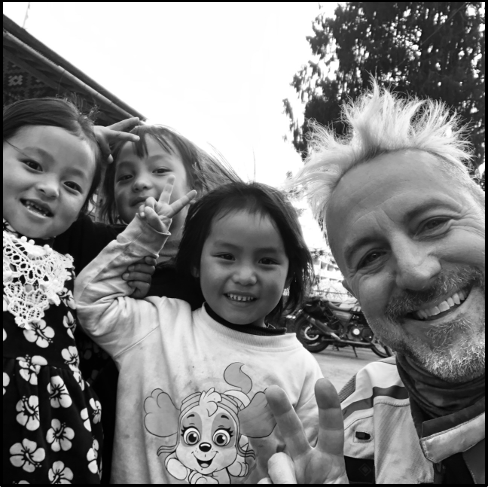
The following is an except from my book 'The Places In Between' written during an around the world motorcycle ride in 2008. Reading these words now, it dawned on me that they could have been written yesterday, so little has changed. Yet some things come to fruition.
Islamic fundamentalists will plan weeks and months in advance to martyr themselves against a Western or even pro-Western target in the Pakistani province of Baluchistan, particularly along the borderlands to Afghanistan. It seems unquestionable that being alerted of our presence, the softest of soft targets, the temptation to score for Bin Laden and Al Qaeda would have been too tempting to pass up. So, whether it was luck or our bodyguards, we managed to exit Pakistan leaving only traumatised nerves behind.Of course, as we waited at the border to cross into Iran, we were fraught with a new apprehension bounding on anxiety. Where the Pakistani government, at least at the diplomatic level, could be considered an ally, Iran was our foremost foe, and we, theirs.
The 200 yards of no man’s land between the Pakistani border post, a cinder block hut which housed history’s most unwelcoming civil servants, and its Iranian equivalent, was a simple dirt path through sand and scrub. As we pulled up to the Iranian station, the contrast was immediate. The well-built, modern structure not unlike a small border station in Europe. It was evident that the crisply uniformed post commander was not in the mood to deal with the American intrusion and we waited an hour in the empty building before being summoned to present our credentials. The visa we had secured through an enormous stroke of luck (many Westerners we had met on the road had been denied, forcing some to take the significantly more dangerous route through Afghanistan), was granted on the condition that we travelled through Iran as part “of a ‘tour’. Our tour, arranged months earlier through a Teheran-based travel agency, consisted of a driver, a guide, and us.
The plan was that they would book accommodations and we would follow them for the next 18 days across the entire expanse of the Islamic Republic. The post commander finally emerged from his office to deal with the Western menace that had interrupted his tea. ‘Why does America not believe we should be able to pursue a nuclear energy program’, was the first loaded question posed. We naturally answered this and all further inquiries with the most pro-Iranian spin possible since an entry rejection would be devastating. He weighed our responses carefully but coldly and after a thirty minute interrogation, approved our entry into his country. On the opposite side of the now opened border gate waited our accompaniment. Komeil, a young, London-based hipster in Iran to visit his ailing mother and to make a bit of cash, and Morteza, a 50-something chain-smoking dissenter of the post-Revolutionary regime who had done time behind bars for his outspoken views. They became our link to this most enigmatic of nations, our guides and our friends.

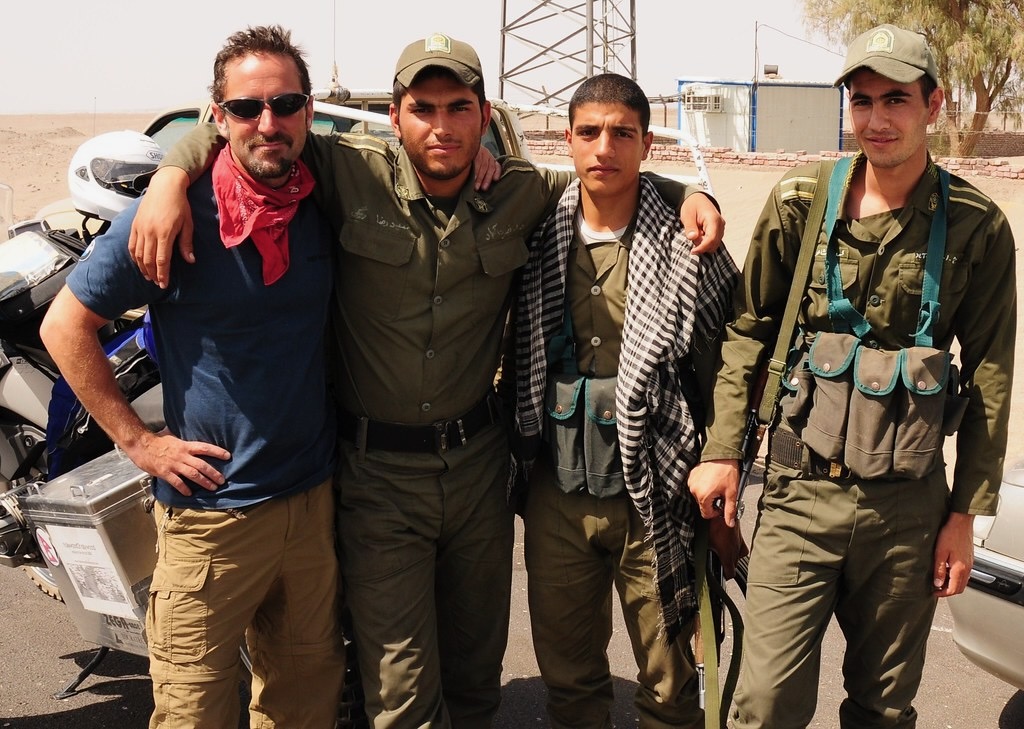
This province of Iran, also called Baluchistan like the province we had just passed through in Pakistan, was also regarded as highly dangerous. But here it was less the threat of Al Qaeda and the Taliban, and more the threat of kidnapping by opium smugglers who had frequently captured Westerners as bargaining chips to secure the release of held comrades. So, in a continuation of our journey across Pakistan, we were issued a security detail of three soldiers manning a heavily armed pickup truck for the ride to our first overnight stop, Zahedan. After some initial posing for photographs next to the bike with the young soldiers and our would-be enemies, we set off to the west for the 120-mile ride to Iran’s eastern-most city. Our security detail was cut short, however, when one of the team spotted something suspicious in the desert to our north, and the pickup pulled off the road, raced through the scrub and was never seen again. Five days into the country, ‘Down with America’ graffiti and queries by the senior military officer on why Iran should not be able to build its own nuclear power plant notwithstanding, we experience a truly remarkable place. After Western Pakistan, it is heaven.
It is secure, the roads are beautiful, the people are extraordinarily kind and things generally work. In the words of so many Pakistanis we met, ‘they are much more civilized there.’ I must admit that I feel privileged to be here in Iran. Governments are changed like so many pair of dirty socks, but the nature of a peoples’ character persists. And when you lop off the escalating, war-mongering rhetoric of both of our governments, what you have left is people who want the same things out of life. You don’t have to go back too far in history to revisit a time when this country was considered one of America’s closest allies.

After ten days in the country, my guard already lowered and I found myself settling into a comfortable rhythm that I haven’t sensed for months. For a moment at least, Iran became my new normal. Yet for all its normalcy, it would be naive to come to a quixotic conclusion that this country can or should survive in its current form. The overt suppression of women’s rights, the containment of reformist political parties and the censorship of media critical of government policies are just a few of the chronic issues that confront forward-thinking people here and the outcome of parliamentary elections a couple of weeks ago does not bode well for change in the near term. But despite those realities, it is very reassuring to also sense that the unadulterated hatred this society appears to harbour toward the West in general and America in particular as depicted by CNN and elsewhere seems to be yet another inflated media myth. People here seem to pick me out of the crowd as a foreigner, but they usually brand me a Spaniard or an Italian. I love to kick back into spectator mode and watch in slow-mo the expressions on their faces when I emit the four syllables ‘A-mer-i-can’. The first reaction is stunned silence. Then their brains process the syllables, and they begin to formulate a response that is appropriate without revealing what the astonished look on their faces has already betrayed. But this uneasiness quickly dissipates as they realize I am indeed as human as they and a warm, brief exchange of questions takes place.
The people I spoke with have without fail been genuinely glad to meet me and have invariably ended each conversation with a hearty ‘Welcome to Iran!’ With the exception of some faded graffiti at the border, I did not see or detect a shred of anti-Americanism, remarkable given the profound ineptitude of the Bush administration. Best of all, the conditions of our visa which mandate our being on a ‘tour’ allowed us to build a great friendship with our two rolling hosts, Komeil and Morteza, and from their different life perspectives (Komeil is 28 and Morteza is 55), we gain views of the Iran of past and present, both good and bad
.
The wind is blowing through my hair as I cruise helmet-less along the avenues lined with boutiques reminiscent of 5th Avenue in New York City. Strands of sunlight mottle through the leaves of the tall elms which tower over the way and sunglasses add more to the cool effect than guarding from the rays. The temperature is an idyllic 82 degrees and the jeans and white t-shirt I am wearing are perfect for the early spring day. The boulevard gradually rises as I head north toward the 16,000-foot mountains of the Alborz Range which now fill the horizon, their peaks still draped with the snow of the season’s cold winter. This is Tehran. This is the city so synonymous with the word ‘terror’ from the days of my youth, the place where U.S. diplomats were held hostage for over a year and made a nation feel powerless to affect their release. The old U.S. embassy, now termed the ‘Den of U.S. Espionage’ in local literature, still bears the scars of the post-revolutionary period. But the faded ‘Down with America’ murals seem to scarcely be noticed now, a relic from more frenzied times.
On a day like today, Tehran can be both Los Angeles and New York. The weather and the mountains are of my west coast home, but the upmarket avenues of North Tehran could easily pass for the Upper East Side. It’s a comfortable place with a high quality of life for the fortunate, a place of civility. As I rolled up and down these streets, that grin of naughtiness from my first day in this country crept back across my face. You see, before I set off today, I removed the duct tape which obscured the mandatory ‘USA’ sticker on the back of the bike since we left India. So here I was, an American cruising the streets of Tehran on a German-made, California-registered BMW with the three bold letters ‘USA’ plastered 4 inches tall on the back case. Yes, I got looks at the traffic lights, glances from the sidewalks and a small crowd in front of the internet café. But ‘Down with the USA’ was not chanted from these people.
Their discourse with me was initiated with one word. ‘Welcome’.Iran is not a travellers’ gem. It is not a France or a Thailand of the Middle East, a tidy, concentration of architectural, cultural and archaeological masterpieces all lined up for easy viewing. It is a vast land of endless deserts with cities and towns of note dotted between the emptiness, as it has been for millennia. The cities I thought would leave me stunned, Yazd, Esfahan and Shiraz were pleasant enough but beautiful would be a stretch. The image of Esfahan, the diamond I had read so much about, was placed on a pedestal higher than the city itself could ever reach. The Imam Mosque dizzied me with its beauty but the Imam Square, the second largest in the world, left me feeling empty with its infinite sea of beige brick facades. The real enjoyment for me in Esfahan was wandering the tree-lined residential streets hunting for the next shot with the Nikon.

But the slight letdown of the marvels of its cities is of no consequence to me. There was only one reason for wanting to travel here. Iran was like the USSR of the cold war: enigmatic for a Westerner and generally perceived as hostile toward our way of life. I never fully bought into that view, and I am glad to have seen the truth. Yes, there are people here who believe Western values are corrupt, have infiltrated their society and must be stopped. And I would be lying if I did not say that at times, I thought the recognition of a U.S. registered motorcycle on their soil may have left us knocked off the road into a ditch somewhere.
But where the flowery Lonely Planet view of Iranians being the warmest, friendliest people on earth is a clear exaggeration (this title belongs to the Thais, the Cambodians, the Lao and the Irish), they nevertheless are more welcoming than the average American. This says a lot because the Iranian man on the street has much more of a reason to hate me than the average American does of him. Iran’s political and religious leaders tell their people the U.S. is evil, and most citizens find no reason not to believe them. The U.N. sanctions against the country, whether justified or not, have caused enormous inflation and unemployment, pain the average family feels daily.
The U.S. has vast military bases virtually surrounding the country in Iraq and Afghanistan and a fleet in the Persian Gulf, which could inflict severe pain if the U.S. government chose to. To the American, Iran is a faraway place full of angry mullahs and sour-faced women under black veils. A distant threat but that is all. And yet despite all of this, after nearly three weeks of riding across 2,000 miles of this country from the scorching Dasht e Lut desert to the lush Caspian Coast to the frozen mountains of Azerbaijan, I have never once felt hated. For the U.S. to choose war against these people would be a travesty of the highest order and, after having experienced so much here, it would be personally heartbreaking as well.
Based in London, Delhi and Austin, Texas, we are a group of people with one concise mission: To expose as many people as possible to the ultimate high of motorcycling the globe.
We believe that travel is the key to understanding our planet and our own place on it. When combined with our love for motorcycles as the mechanism for exploration – out there and at one with the elements – Two Wheeled Expeditions creates experiences like none other in the world.

.png)
.png)