Two Up in The Tropical Pearl of the Orient - Sri Lanka
by Toni Harris | 25 Apr, 2026
Iain and I have been travelling by motorbike for over 20 years, having ridden in about 50 countries. All that riding has been two-up on BMWs, with my role being logistics director (booking accommodation, route planning, finding restaurant recommendations), while Iain ensures the bike keeps rolling.
Having decided we wanted to explore Sri Lanka, we made the decision to do a group tour rather than plan the trip independently. After years of handling every detail ourselves—routes, accommodation, timing, and the inevitable on-the-road problem solving—it felt like a luxury to hand the logistics over to people who knew the country inside out. Having local guides who knew the back roads, the fuel stops and the best places to for lunch. Best of all, the group experience added a social layer we hadn’t expected to enjoy so much—swapping stories over dinner and laughing about the day’s mishaps, and talking about biking adventures.
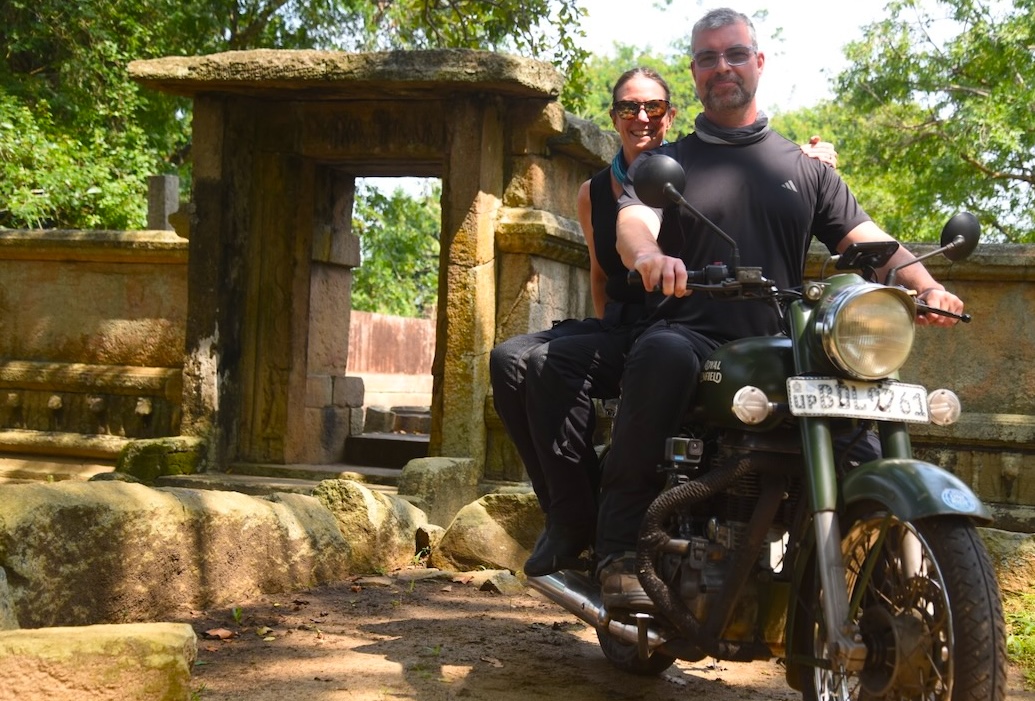
There were eight bikes in our group, with Iain and me being the only ones travelling two-up, along with our tour leaders, Amila and Roro (Roro being one of the founders of the company). We were a mixed bunch from the UK, Australia, Canada and NZ. We were introduced to our new ride, a Royal Enfield 350 Classic, which would be taking us on a 1,200 km loop of Sri Lanka over the next 12 days. I had been very worried that, after the comfort of our new BMW 1300 GSA Adventure, the little Royal Enfield would feel cramped, and that Iain and I would spend the coming days pressed up against each other. There should have been “no worries”: the bike was longer than I expected, the pillion seat was super comfy, and there was a backrest.

The Royal Enfield Classic 350’s 20 hp doesn’t sound like much, and we did wonder how it would cope with two of us especially once we got into the hills. Would we be left behind or hold the others up? But in the hills, it never felt strained; it just settled into its rhythm and chugged up the climbs with that steady, tractor-like determination Enfields are known for.
The first day’s ride was north along the coast to Kalpitiya. First, we had to exit Colombo, but luck was on our side – it was a public holiday, and the traffic was not as chaotic as expected. It was a gentle introduction to Sri Lankan roads, with small motorbikes, tuk-tuks, and buses dominating the traffic with seemingly no rules. We rode along the coast past endless palm plantations, charming churches and lots of fresh fish markets. The temperature was high and it was humid, but roadside stops for fresh coconuts helped with the hydration.
Day two had us heading inland, leaving views of the Indian Ocean behind. A small detour via an unpaved road to some ruins led to some interesting times, with several bikes getting stuck in thick mud and even a couple of topples. Iain got stuck in (and rather muddy!) helping to get bikes upright and out of the mud. I sensibly chose to dismount and walk some of the muddier sections! The afternoon ride took us to Sigiriya, through palm plantations, rice paddies, and jungle, to one of Sri Lanka’s most famous sites: the 200-metre-high Lion’s Rock.
We rose before dawn the following day to climb Lion Rock’s 1,200 steps and see sunrise from the top. It was a challenge, but worth it for the views. Sigiriya is an ancient rock fortress that dates back to the reign of King Kasyapa (477–495 AD), who chose this site as his new capital. He decorated the walls with frescoes (many of which depicted topless women) and built an impressive palace right on top of the rock column, accessible only through the mouth of an enormous carved lion.
Day three’s riding was on quieter roads with lovely sweeping bends, and the odd river culvert which—if hit at speed—had me airborne and squawking. A series of 18 hairpins had us climbing through tropical forests. Very evident on the side of the roads were large piles of dirt and rocks, the result of some devastating weather in December 2024.
We should have known we were in for another great day’s riding when our guide, Amila, turned up at breakfast in a T-shirt saying, “I’m so excited”. We spent the day continuing to climb through tea plantations and past waterfalls, riding on a fantastic, sweeping, newly paved road. Our lunch stop was the best of the week: barbecued freshwater fish, creamy dahl, fresh salads, and sublime samosa, all prepared fresh at a family-run roadside restaurant. The kids had lots of fun taking selfies and sitting on the bikes. The day ended in the bustling hill station of Ella.

A day off the bikes had us on a train climbing further through tea plantations and across the infamous Nine Arches Bridge to the hill station of Haputale. From there it was a crazy ride in a tuk-tuk, continuing to climb through undulating fields of tea to the high point of Lipton’s Seat, followed by a tour of a tea plantation to learn the intricacies of tea production using equipment unchanged in decades. From the hilltops of the tea plantations it was time to start winding our way down to the southern plains. A drink stop at a waterfall gave me the chance to watch a group of monkeys having fun—rough-and-tumble play, leaping into trees, sitting on our motorbikes, and one eating the leftovers of an ice cream. The end of the ride to a lovely resort on the edge of a river had us passing elephants at the side of the road.
After a morning of relaxing, we headed off in jeeps to explore Udawalawe National Park. The park is a 30,820-hectare wildlife sanctuary in Sri Lanka’s dry zone, renowned for its population of approximately 400 wild Asian elephants, along with water buffalo, crocodiles, and diverse bird species. During our drive through the park, we were lucky enough to see a three-month-old baby elephant with its mother.
We rode on again towards Tangalle Beach on the south coast, anticipating our first swim in the ocean. The first stop of the day was to visit one of the country’s most ancient Buddhist sites: the 1,000-year-old Sandagiri Stupa.
We briefly rode one of the country’s few fast highways, notable for the surprising presence of a herd of water buffalo. That evening we were treated to an amazing seafood dinner of fresh mahi mahi cooked on a barbecue before retiring to cabanas shaded by tall palms overlooking the Indian Ocean.
During our penultimate day’s ride we stopped at a local school that TWE helps to support. The children were so excited to see us and the motorcycles, but even more excited to have an excuse to skip class and play on the slide. The evening was spent in the UNESCO World Heritage City of Galle. Founded by the Portuguese in the 16th century, the walled fort is surrounded by the Indian Ocean on three sides. Our hotel for the evening was a beautifully restored Dutch colonial building in the heart of the town, and the huge four-poster bed in our room was a luxury.

I was a bit apprehensive about the last day of the tour, as it would take us back towards the capital on busy roads. After taking us to his home for lunch and to meet his family, Amila took us to a nearby Buddhist temple for a blessing. Perhaps we would be needing it, I thought! Amila then led us on various crafty detours to avoid some of the mayhem, but eventually we were in the thick of it—navigating around tuk-tuks and hastily getting out of the way of any fast-moving buses as they barrelled through. By this point the group was riding together like a well-oiled machine, accustomed to the Sri Lankan driving style and weaving through the traffic like we’d been doing it for years.
The final section of the ride into Colombo and back to our starting point at the Galle Face Hotel was nothing short of exhilarating and we celebrated the end of our wonderful tour of Sri Lanka with high fives and hugs all round.
As a final note – if after a couple of weeks on the bike, you are looking for something relaxing and special the Maldives are only a 70min direct flight from Colombo and some of the best Tuna I have ever eaten.




.png)
.png)